

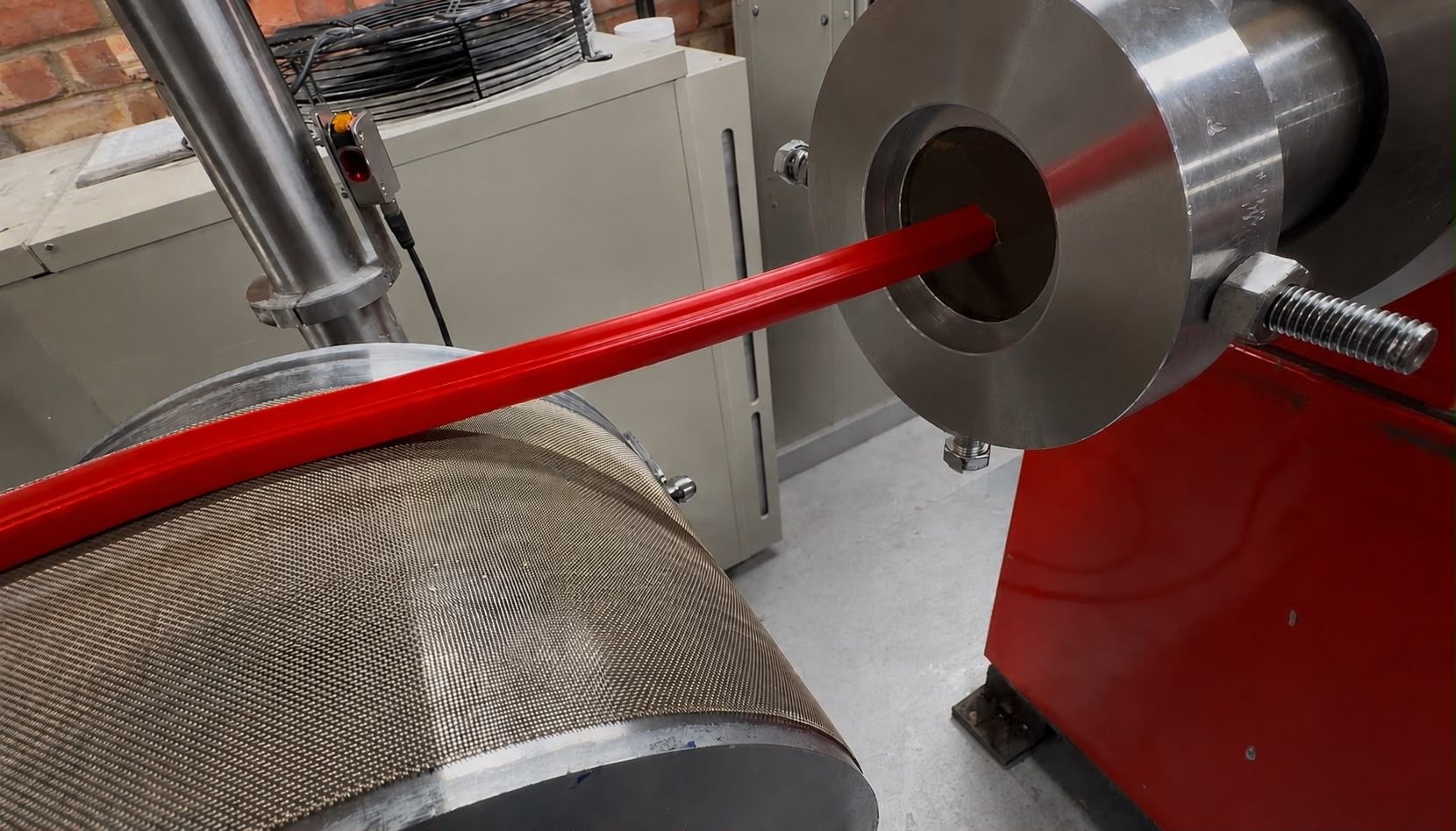
Silicone rubber extrusion is a manufacturing process used to produce continuous lengths of tubing, cord, seals and profiles with a consistent cross-sectional shape. It combines precision tooling with carefully controlled mixing, extrusion and curing processes. The result is a flexible silicone component designed to perform reliably in industrial, regulated and performance-critical applications.
What Is Silicone Rubber Extrusion?
To understand the process, it helps to begin with the finished product. A silicone extrusion is a continuous profile that retains the same shape along its entire length. Common examples include round cord, hollow tubing, U channels, P sections, D sections and rectangular strips.
The process starts with uncured silicone rubber. This soft, malleable material is forced through a precision-engineered metal tool, commonly called an extrusion die. The opening in that tool determines the basic cross-sectional shape of the finished profile.
Once the silicone leaves the die, it passes through controlled heating stages. These cure the rubber, stabilise its shape and provide the physical properties required for its intended application.
Unlike moulding, which normally produces individual components within a shaped cavity, extrusion is suited to continuous lengths. The material can then be supplied in coils, cut to specified lengths or fabricated into finished seals, gaskets, joined rings and frames.
Our silicone rubber extrusion manufacturing capabilities support both existing profiles and bespoke designs developed around a specific enclosure, panel, door, pipe or sealing surface.
How Does Silicone Rubber Extrusion Work?
Once the basic principle is clear, the manufacturing stages explain how a repeatable profile is produced.
Preparing and mixing the material
Silicone rubber typically arrives as a translucent block of soft, uncured material. Before extrusion, it is mixed on a two-roll mill with the appropriate catalyst, pigments and performance additives.
The formulation depends on the required colour, hardness, operating environment and regulatory needs. Each batch must be prepared consistently because variations at this stage can affect dimensions, surface finish, curing behaviour and long-term performance.
At Advanced Materials, we custom-mix material for each order and retain thousands of material and colour formulations. This supports repeatability when customers reorder established parts.
Extruding the profile
The prepared silicone is fed into an extruder, which applies controlled pressure and pushes the material through the die. Although the die opening defines the profile, producing the correct finished dimensions requires practical extrusion knowledge.
Silicone changes as it passes through the tool and cures. The toolmaker must allow for material flow, expansion and shrinkage rather than simply reproducing the final drawing dimensions in metal.
Initial curing
After leaving the die, the continuous extrusion travels through a hot-air curing tunnel. This initial cure gives the profile enough stability to be handled without returning to its original malleable state.
Operators monitor dimensions during production through patrol inspection. This allows adjustments to be made before a full batch is completed, reducing the risk of unsuitable material progressing to later manufacturing stages.
Post-curing and inspection
Where required, the extrusions are placed in post-curing ovens. Advanced Materials commonly post-cures suitable products for four hours at 200°C before allowing them to cool and completing the final quality inspection.
Post-curing can help complete the curing process and support properties such as compression set, cleanliness and stability. The correct treatment depends on the silicone grade and application requirements.
The fully cured material can then move to dispatch, cutting or joining. Production samples are retained for a minimum of five years, supporting traceability and future quality checks.
As Technical Director Villeater Gladman explains, “The manufacture of your specific products may involve slightly different steps.”
This is important because tooling, curing and finishing must be matched to the profile rather than treated as a fixed process for every order.
Why Use Silicone Rubber?
The extrusion process creates the shape, but the material determines how that profile performs in service. Silicone is often specified when conventional rubbers may harden, crack or lose flexibility over time.
Temperature resistance
Silicone rubber retains useful flexibility across a broad temperature range. This makes it suitable for seals and protective profiles exposed to heat, cold or repeated temperature cycling.
Actual temperature capability depends on the grade, formulation, duration of exposure and operating conditions. Material selection should therefore consider more than a single maximum-temperature figure. Our silicone rubber technical details provide further guidance on material properties.
Long-term exposure must also be considered. Heat can gradually change an elastomer’s physical properties, even where immediate failure does not occur. Our guide to thermal ageing of silicone rubber explains why time, temperature and material formulation all matter.
Weather, UV and ozone resistance
Why does silicone rubber perform well outdoors? Its molecular structure provides strong resistance to weathering, ultraviolet exposure and ozone compared with many conventional organic rubbers.
This makes silicone suitable for external seals around lighting systems, windows, doors, enclosures and transport equipment. It can remain flexible where an unsuitable material might become brittle, cracked or permanently deformed.
Outdoor performance still depends on the complete application. Joint design, compression, movement, chemical exposure and installation quality must all be assessed before selecting a grade.
Flexibility and durability
Silicone can remain flexible through changing operating conditions, helping a seal accommodate movement and dimensional variation. This is particularly valuable where components are repeatedly opened, closed, compressed or exposed to vibration.
For example, an electrical enclosure installed outdoors may experience summer heat, winter cold, moisture and regular maintenance access. A correctly designed silicone gasket can maintain contact with the sealing faces while resisting environmental ageing.
However, silicone is not automatically better than every other rubber. Some applications demand greater abrasion, oil or dynamic fatigue resistance. Material choice should be based on the actual environment rather than a general preference for silicone.
Food and pharmaceutical applications
Approved silicone grades can be used for food-contact and pharmaceutical equipment where cleanliness, temperature resistance and documentation are important.
The correct grade must be selected against the relevant regulatory requirement. A material being described as silicone does not, by itself, make it suitable for food or pharmaceutical use. Buyers should confirm the formulation, supporting documentation and manufacturing controls before placing an order.
Colours, grades and Shore hardness
Silicone rubber is available in translucent material and a wide range of colours. Colour matching can support identification, branding, production control or visual differentiation between grades.
Different formulations can also provide properties such as flame retardancy, electrical conductivity or enhanced tear strength. These are specialist materials and should only be specified where the application requires them.
Hardness affects how easily a profile compresses, bends and recovers. Softer silicone may conform more readily to an uneven surface, while harder material can provide greater resistance to deformation. Our article on what Shore hardness is and how it is measured explains this important selection factor.
What Types of Silicone Extrusions Can Be Manufactured?
With the material requirements established, the next consideration is the profile itself. Silicone rubber extrusion can produce simple shapes such as tubing, cord and square strips, as well as more detailed sealing profiles. Frequently manufactured sections include U channels, P sections, D sections, rectangular strips and profiles designed around customer drawings.
Tubing may be used to carry air or liquids, protect cables or provide flexible sleeves. Cord can be supplied in continuous lengths or joined into O-rings. Channel profiles can protect panel and glass edges, while hollow sections can provide controlled compression around doors and enclosures.
More complex profiles may combine sealing lips, fixing features, hollow chambers and locating sections within one extrusion. Their suitability depends on wall thickness, overall dimensions, tolerances and whether the shape can be extruded and cured without distortion.
Typical tolerances depend on profile size and geometry, although tighter tolerances than industry standard can often be achieved for critical applications.
Designing a Custom Silicone Extrusion
Standard sections are useful, but many engineering problems require a profile developed for a particular assembly.
The design process should begin with the application rather than the tooling. Important information includes the sealing surface, available fitting space, expected compression, operating temperature, movement, chemicals, regulatory requirements and preferred method of installation.
A common purchasing problem occurs when a sample is supplied without explaining how the component works. Two profiles may look similar but behave differently once compressed. Providing a drawing, mating dimensions and application details allows the manufacturer to assess whether the design is practical.
Advanced Materials has more than 10,000 existing extrusion dies, so a suitable tool may already be available. Where no existing option meets the requirement, our in-house tooling and design service can produce a bespoke die.
Keeping tooling design and manufacture in-house also improves communication between technical, toolmaking and production teams. Potential manufacturing issues can be considered before full production, helping customers reduce redesign work, delays and avoidable cost.
Common Applications for Silicone Rubber Extrusions
Once the profile and material are matched correctly, silicone extrusions can solve a wide range of practical manufacturing challenges.
They are commonly used to prevent dust, moisture, air or liquid ingress. They can also protect glass, sheet metal, cables and finished edges from contact damage.
Hollow or flexible profiles may provide cushioning, reduce vibration and limit noise between assembled components. Other applications include window and door seals, electrical enclosure gaskets, lighting systems, HVAC equipment, food-processing machinery, pharmaceutical equipment and general industrial assemblies.
Is silicone good for rubber seals?
It can be an excellent choice where temperature stability, environmental resistance, cleanliness or long service life are priorities. It may be less suitable where the seal faces severe abrasion or contact with substances incompatible with the selected grade.
The most reliable approach is to review the complete operating environment before approving the material and profile.
Why Choose Advanced Materials?
Choosing the right manufacturing partner is as important as selecting the material. Advanced Materials is a UK manufacturer with more than 30 years of silicone extrusion experience. We provide in-house material preparation, toolmaking, extrusion, joining and post-curing, supported by technical design assistance.
Our two dedicated toolmakers support new profile development, while our existing die library can shorten the route to production where a suitable section is already available.
We manufacture under ISO 9001:2015 and ISO 14001:2015 systems, alongside EC 2023/2006 Good Manufacturing Practice requirements where applicable. Production samples are retained to support traceability, giving engineering and procurement teams greater confidence when managing repeat orders.
Our role is not simply to supply a length of rubber. We work with customers to understand the application, check the specification and identify a manufacturable solution. This helps reduce the risks associated with unsuitable materials, inconsistent profiles and unclear technical requirements.
Speak to a Silicone Extrusion Specialist
Understanding what silicone rubber extrusion is provides a useful starting point, but successful specification depends on the application. Material grade, hardness, profile geometry, curing and finishing must work together.
Advanced Materials manufactures bespoke silicone extrusions for industrial and regulated sectors in the UK and internationally. To discuss a new profile, replacement seal or existing drawing, speak to our technical team or request a quotation.